
Late eighteenth-century America presented a striking contradiction. A nation built on ideals of liberty continued to allow slavery to persist across its society. Public declarations praised freedom and equality, yet daily life for many people of African descent remained defined by bondage and exclusion.
Benjamin Banneker, a self-taught African American mathematician, astronomer, and surveyor, achieved distinction through discipline and intellectual rigor.
Born to a free Black woman and a father who had once been enslaved, Banneker gained recognition for publishing almanacs between 1792 and 1797. His work demonstrated advanced knowledge in astronomy and mathematics, challenging widespread assumptions about Black intellectual capacity.
Thomas Jefferson held a powerful position in 1791 as Secretary of State. Known as the principal author of the Declaration of Independence, he publicly promoted ideals of liberty.
At the same time, he owned enslaved people and had expressed doubts about Black intellectual ability in his earlier work, Notes on the State of Virginia. Such contradictions shaped his public and private identity.
Correspondence between Banneker and Jefferson began when Banneker sent a letter dated August 19, 1791, along with a copy of his almanac manuscript.
Benjamin Banneker’s Letter (August 19, 1791)
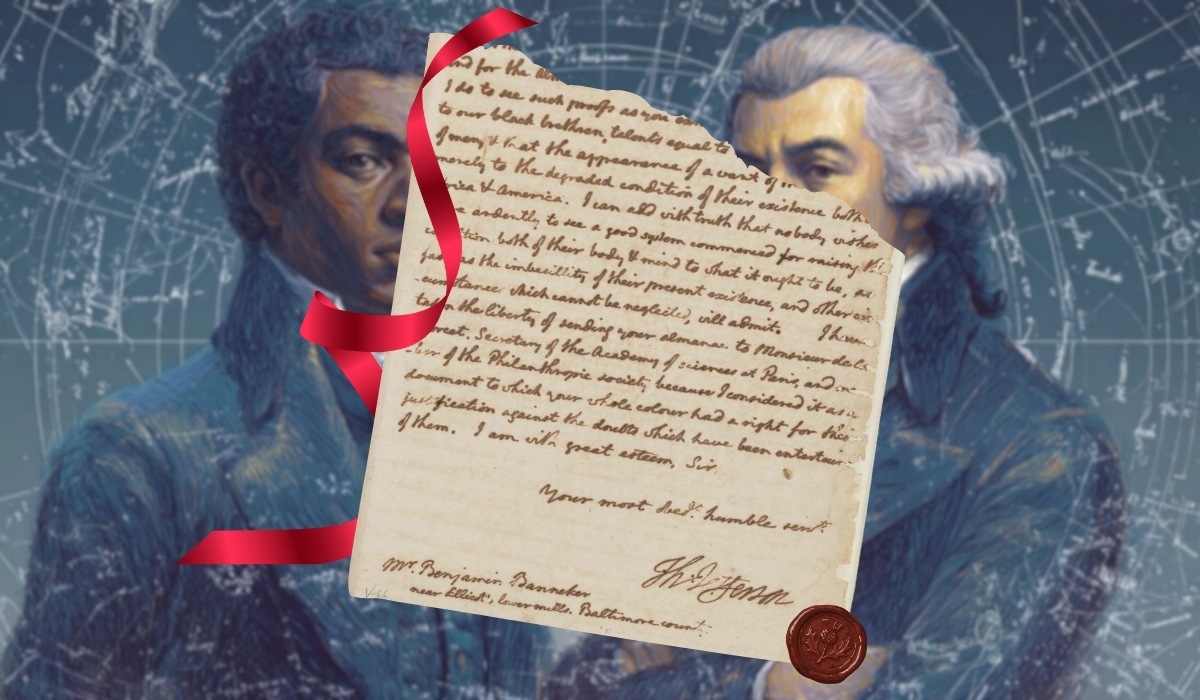
Banneker’s letter functioned as both a personal communication and a carefully constructed argument against prevailing racial assumptions. Intellectual discipline, moral conviction, and calculated restraint shaped every part of his message.
Opening lines established respect, which allowed him to address a powerful political figure without risking immediate dismissal.
Banneker opened his letter with respectful language, acknowledging Jefferson’s political status and accomplishments. Careful wording established credibility and maintained decorum. Persuasive reasoning combined with moral and religious arguments shaped the message.
A balance between deference and firm critique allowed Banneker to confront Jefferson without direct hostility.
Key Arguments
Central claims in Banneker’s letter developed through layered reasoning that connected political history, moral principles, and lived experience.
The hypocrisy of slavery formed a central argument. Banneker reminded Jefferson of his role in declaring liberty during the American Revolution. References to resistance against British tyranny created a parallel between colonial oppression and the suffering of enslaved people.
Enslaved individuals endured conditions similar to those once condemned by American colonists.
- Colonists protested taxation and the lack of representation
- Enslaved people experienced forced labor and a complete loss of freedom
- Both situations involved the denial of basic rights and human dignity
Such reasoning suggested that Jefferson should recognize the injustice due to his own experience with oppression.
Shared humanity and divine creation also played a major role. Banneker stated that all humans are “of one flesh” and created by God. Religious reasoning reinforced the idea that no group held natural superiority over another.
His argument drew strength through several connected ideas:
| Idea | Meaning |
|---|---|
| A single divine origin for all people | All human beings share the same origin and are viewed as part of one human family. |
| Equal moral worth granted by God | Every person possesses equal dignity and value regardless of social status or background. |
| Responsibility to treat others with justice and compassion | Moral duty requires fairness, empathy, and humane treatment toward all people. |
The challenge to racial inferiority appeared directly in the letter. Banneker addressed Jefferson’s earlier claims regarding Black intellectual limitations.
Presentation of his own achievements stood as evidence against those claims.
- Personal success in astronomy and mathematics contradicted claims of inferiority
- Publication of almanacs demonstrated advanced knowledge and discipline
- Intellectual output provided visible proof that could not be dismissed easily
Use of Evidence and Strategy

Careful structure and varied forms of reasoning gave Banneker’s letter its strength. He did not rely on a single type of argument but combined multiple approaches to reinforce his position.
Enlightenment reasoning shaped much of Banneker’s argument. Ideas about universal rights and human equality supported his claims. Logical structure and clear parallels strengthened his position.
His use of Enlightenment thought included:
| Element | Meaning |
|---|---|
| Reference to natural rights shared by all people | Emphasizes that freedom and basic rights belong equally to every human being. |
| Logical comparison between American colonists and enslaved individuals | Highlights the contradiction between demands for liberty and the existence of slavery. |
| Consistent reasoning that exposed contradictions in accepted beliefs | Uses rational argument to challenge ideas that justified unequal treatment. |
Religious reasoning invoked God as a moral authority. Moral responsibility became tied to both faith and justice.
- Assertion of divine creation as a source of equality
- Moral obligation to reject oppression
- Connection between religious belief and ethical action
Empirical proof appeared through the inclusion of his almanac. Work in astronomy and mathematics demonstrated intellectual capability in a tangible form. His almanac functioned as concrete evidence:
- Detailed astronomical calculations showing precision and expertise
- Published work accessible to a broad audience
- A physical demonstration of intellectual achievement
Tone management remained essential throughout the letter. Banneker avoided aggressive confrontation while delivering a powerful critique, ensuring that his message could not be dismissed as disrespectful.
His tone achieved several outcomes:
| Outcome | Explanation |
|---|---|
| Maintained respect toward Jefferson’s position | Presented disagreement without dismissing Jefferson’s status or influence. |
| Delivered criticism in a controlled and reasoned manner | Used measured language to communicate objections clearly and effectively. |
| Strengthened credibility by avoiding emotional excess | Helped the argument appear thoughtful, balanced, and persuasive. |
Thomas Jefferson’s Response (August 30, 1791)
Jefferson’s reply followed a careful path shaped by his political role and personal beliefs. His response acknowledged Banneker’s accomplishments while avoiding broader commitments that might challenge existing systems.
Jefferson responded with politeness and diplomacy. He expressed appreciation for Banneker’s almanac and acknowledged its quality. Careful wording revealed caution, avoiding strong commitments.
Key Points
Jefferson’s response contained several notable ideas that revealed both openness and limitation. His statements suggested recognition of individual achievement while maintaining distance from larger implications.
Acknowledgment of Black intellectual ability appeared in Jefferson’s response. He stated that he hoped to see evidence that Black people possess equal mental capacity. Such phrasing suggested openness, though it framed equality as something requiring validation.
- Recognition of Banneker as an example of intellectual ability
- Continued doubt about broader equality
- Placement of burden of proof on Black individuals
Recognition of systemic barriers emerged as another point. Jefferson suggested that limited opportunities, rather than natural ability, might explain differences in achievement.
Such a statement hinted at social constraints affecting education and advancement.
- Restricted access to education for Black individuals
- Social and economic limitations imposed by slavery
- Unequal conditions shaping intellectual development
Avoidance of a strong anti-slavery stance remained evident. Jefferson did not address abolition directly and did not confront his own role as a slaveholder.
- Reluctance to challenge established systems
- Separation between intellectual acknowledgment and political action
- Continued participation in slavery despite stated ideals
Actions Taken
Jefferson took a specific step that gave Banneker’s work international visibility. That action carried symbolic meaning but limited practical impact on American society.
Jefferson sent Banneker’s almanac to the French Academy of Sciences. He included a note presenting it as evidence of Black intellectual capability.
His decision involved several key elements:
| Key Element | Explanation |
|---|---|
| Presentation of Banneker as an example to a respected scientific institution | Used Banneker’s work to demonstrate intellectual achievement before an influential audience. |
| Recognition of the importance of empirical evidence | Relied on observable results and documented work rather than abstract claims. |
| Framing of the almanac as proof of intellectual potential | Presented the almanac as concrete evidence of scholarly ability and reasoning. |
Such an action indicated a willingness to share Banneker’s work in an international context. At the same time, it did not signal commitment to broad social reform.
Analysis of the Exchange

Exchange between Banneker and Jefferson reveals a complex interaction shaped by intellect, power, and contradiction. Each participant operated within different constraints, leading to a layered and revealing dialogue.
Power Dynamics
Banneker occupied a position of limited social power as a free Black intellectual. Through education and disciplined reasoning, he challenged a prominent political leader. His letter asserted equality through intellect and moral argument.
- Limited access to institutional authority
- Risk of dismissal based on racial prejudice
- Need to rely on reason and evidence rather than status
Jefferson held political authority and cultural influence. His response operated within social and political constraints of his time, maintaining caution.
His position included:
| Aspect | Explanation |
|---|---|
| Responsibility as a national leader | Required balancing personal views with obligations to the nation. |
| Influence over public opinion and intellectual discourse | His words and decisions shaped how important issues were discussed publicly. |
| Constraints tied to maintaining political stability | Political realities limited how far he could act without risking broader instability. |
Contradictions in Jefferson’s Position
Tension between Jefferson’s public ideals and private actions appeared clearly in this exchange. His response revealed inconsistencies that shaped early American thought.
Public support for liberty contrasted with personal involvement in slavery. Ownership of enslaved people conflicted with ideals expressed in the Declaration of Independence.
- Advocacy of equality alongside participation in slavery
- Recognition of injustice without direct action
- Intellectual acceptance without political commitment
Acknowledgment of Banneker’s intellect did not lead to a clear statement supporting equality. Framing equality as something to be proven revealed hesitation and uncertainty.
Significance of Banneker’s Letter
@ashleytheebarroness Black Excellence: Benjamin Banneker #blackexcellence #blackhistory #americanhistory #historytok #fyp ♬ original sound – Ashley
Banneker’s letter marked an important moment in early American history. His words demonstrated that intellectual resistance could challenge deeply rooted beliefs.
Banneker’s letter represents one of the earliest recorded instances of an African American directly challenging a Founding Father.
Intellectual resistance to racism appeared clearly through logic, moral reasoning, and evidence. Use of Enlightenment ideals against inconsistent application revealed a powerful critique of early American thought.
Summary
Correspondence in 1791 exposed a fundamental contradiction in early American democracy. Ideals of liberty coexisted with systems of oppression.
Banneker offered a powerful moral challenge grounded in faith and logical reasoning. His letter combined respect with a firm critique.
Jefferson’s response showed openness to individual achievement yet reluctance to support systemic change.
The enduring importance of this exchange lies in its insight into race, intellectual history, and the limits of Enlightenment ideals in practice.