
Benjamin Banneker (1731-1806) lived during the colonial and early national periods in Maryland and gained recognition as an African American farmer, mathematician, astronomer, and writer. Life unfolded primarily on his family’s farm in Baltimore County, Maryland.
Agricultural work formed the foundation of daily activity, yet intellectual curiosity also played an important role in his routine. Long hours in fields coexisted with evenings devoted to reading, studying mathematics, and observing the sky.
Circumstances surrounding his birth shaped many opportunities in his life. Birth into a free African American family allowed access to land ownership and education in a society dominated by slavery.
Farm work, family cooperation, and curiosity about science developed side by side within that rural setting.
Life on Banneker’s colonial farmstead combined constant agricultural labor with family responsibility, self-directed learning, and scientific observation.
Let’s go through it.
The Banneker Family and the Farm’s Origins
Benjamin Banneker entered the world on November 9, 1731, in Baltimore County, Maryland. Family background played an important role in shaping his position in colonial society.
Mary Banneky, his mother, lived as a free African American woman in a region where slavery dominated labor systems. Robert, his father, had once lived in bondage after transportation out of West Africa. The purchase of his freedom allowed him to live as a free man and establish a household.
Freedom of both parents meant Banneker entered life without legal bondage. Status as a free person allowed him opportunities unavailable to many African Americans living in British North America during the eighteenth century.
The ability to learn basic literacy, assist in farm ownership, and participate in local economic life developed under those circumstances.
Family influence also encouraged curiosity and discipline. Grandmother and mother played key roles in teaching early reading skills. Household life mixed agricultural work with lessons in literacy and moral instruction.
Work in fields during daylight hours often occurred alongside quiet time spent learning to read or practicing numbers.

Establishment of the Farmstead
Creation of the Banneker colonial farmstead marked an important development in family history. Ownership of land allowed stability, independence, and a reliable source of livelihood during the colonial period.
Acquisition of farmland occurred in 1737 when members of the family obtained a 100-acre property located in the Patapsco Valley area of Maryland. Land provided space for crops, livestock, and family residence. The property later became known as Banneky Farm.
Location near modern-day Oella placed the farm within a rural agricultural region of Baltimore County. Natural conditions supported farming and daily household activity.
The residence of the Banneker family remained tied to that land for decades. Benjamin spent most of his life living and working at that colonial farmstead. Farm environment shaped his daily routine and created space for both labor and learning.
Agricultural property functioned as both workplace and home. Fields demanded constant attention, while evenings often allowed moments for reading or observing nature. Life in such surroundings encouraged careful observation of weather, seasons, and natural patterns.
Daily Life and Work on the Colonial Farmstead
Daily routines at a colonial farmstead required discipline, physical labor, and careful management of natural resources. Agricultural survival depended on cooperation within the household and knowledge of seasonal farming cycles.
Work on Banneker’s property reflected many patterns common in eighteenth-century Maryland farming communities.
Farming Responsibilities
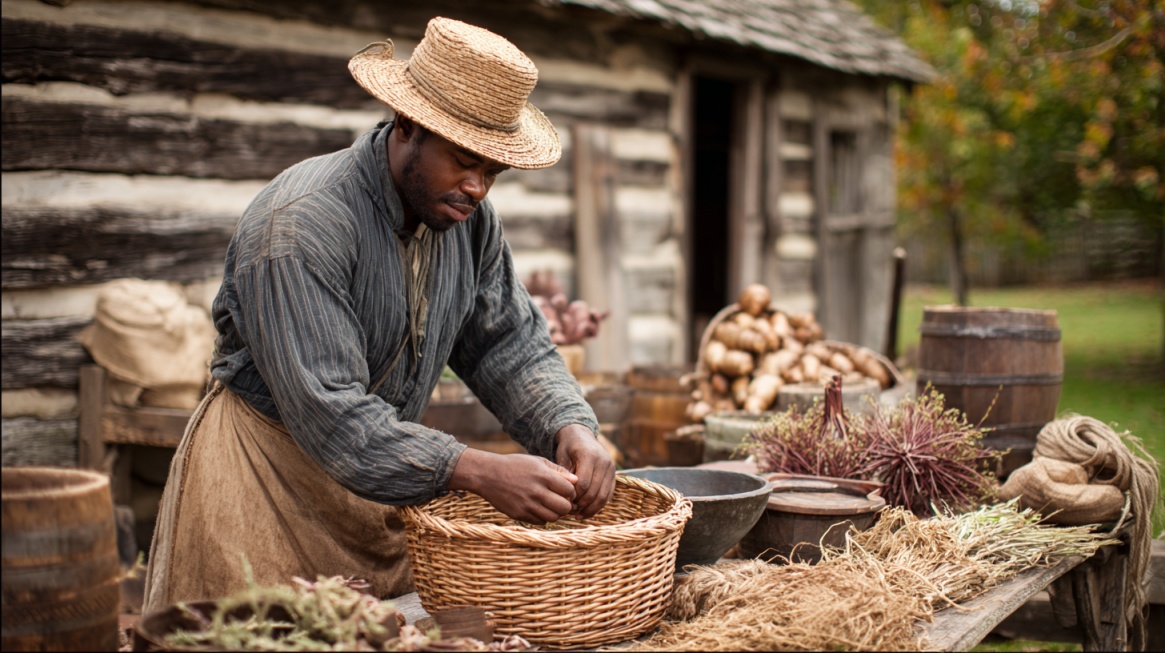
Agriculture formed the core of everyday life on the Banneker colonial farmstead. Colonial farmers depended heavily on crop production to support their households and generate income.
Tobacco ranked as one of Maryland’s most important cash crops during the eighteenth century, and farmers across the region cultivated it for sale.
Family members participated in numerous tasks connected with agriculture. Activities required steady effort throughout the year.
- Preparing soil and planting seeds during the spring months
- Maintaining fields and removing weeds during growing seasons
- Harvesting crops in late summer and early autumn
- Preparing tobacco leaves for drying and market transport
Responsibility for managing these tasks eventually passed to Benjamin Banneker after his father died in 1759. Leadership of the colonial farmstead required careful planning and steady labor.
Management of farmland depended on observation and experience. Farmers monitored rainfall, soil condition, and seasonal temperature changes. Successful harvests required attention to each of these factors.
Agricultural Innovation
Work on the Banneker colonial farmstead did not rely only on traditional farming methods. Practical problem-solving helped improve crop survival and field productivity.
Banneker designed an irrigation system that guided water through a series of ditches and small dams. Nearby springs supplied water that could be redirected across farmland.
Design allowed water to reach crops during dry periods. Crops received moisture even during seasons with little rainfall. System-protected harvests and allowed greater stability in agricultural production.
- Small dams built to control water flow
- Ditches carved through soil to direct water toward fields
- Use of natural springs located on the property
- Gradual distribution of water across crop areas
The development of that irrigation method demonstrated careful observation of the land. Knowledge of slopes, water movement, and soil absorption allowed Banneker to adapt natural resources for agricultural success.
Farm Structures and Environment
Physical surroundings of the Banneker colonial farmstead shaped both daily labor and household life. Farm properties during the eighteenth century usually contained a modest residence along with open fields and natural water sources.
The family home likely consisted of a wooden or log structure typical of rural Maryland farms. The building offered shelter, cooking space, and areas for family gathering.
- Wooden or log house used as family residence
- Open agricultural fields for crop production
- Wooded sections supplying timber and firewood
- Springs and nearby Patapsco River providing water access
The rural setting influenced the rhythm of everyday activity. Agricultural labor occupied daylight hours, while quieter evenings created time for study and reflection. Night skies visible across open land later played an important role in Banneker’s astronomical work.
Family Cooperation
Success of any colonial farmstead depended on cooperation among household members. Shared labor allowed families to maintain crops, manage property, and sustain daily life.
After Robert Banneker died in 1759, Benjamin assumed responsibility for maintaining the property and supporting his mother and sisters. Leadership required balancing agricultural labor with household needs.
Daily work often involved several family members working together on different tasks.
- Planting crops and maintaining fields
- Repairing fences and clearing land
- Maintaining irrigation channels and water flow
- Preparing food and preserving harvest supplies
Life on the colonial farmstead required persistence and shared effort. Cooperation among family members ensured continued operation of the farm and stability within the household.
Education and Intellectual Life on the Farm
Intellectual development within a colonial farmstead often occurred through informal learning and personal curiosity. Formal schooling remained limited for many rural residents during the eighteenth century. Banneker’s education developed through family instruction, short periods of schooling, and long hours of independent study.
Early Education
Education began at home during Banneker’s childhood. Grandmother and mother introduced reading skills and basic literacy. Lessons at home allowed him to recognize letters, read simple passages, and practice writing.
Attendance at a small Quaker school located near the farm later expanded his learning.
- Reading and writing practice
- Arithmetic and number exercises
- Moral instruction common in Quaker education
Formal schooling lasted only a short period. Despite limited classroom instruction, those lessons created a foundation that supported future intellectual growth.
Literacy opened access to books and written materials. Reading allowed Banneker to pursue subjects that interested him long after school attendance ended.
@africanheritagecity @African Stream • BRILLIANT BANNEKER The son of a slave and a self-taught whizz-kid who predicted solar eclipses. Here’s a reminder of the amazing life of Benjamin Banneker. An eminent African-American intellectual who also took on the US government over Black civil rights. #Black #CivilRights #westandontheshouldersofourancestors #blackhistory365 ♬ original sound – africanheritagecity
Self Education
Self directed study became a central part of Banneker’s intellectual life. Agricultural work demanded many hours during daylight, yet evenings often allowed quiet time for learning.
Books and written materials guided much of his progress. Careful reading combined with repeated calculation practice allowed him to develop skill in mathematics and astronomy.
- Mathematical calculation and number patterns
- Astronomical observations of stars and planets
- Mechanical devices and measurement techniques
Rural environment of the colonial farmstead created favorable conditions for concentration. Limited distractions and quiet surroundings allowed sustained attention to reading and calculation.
Scientific Curiosity
Curiosity about science appeared early in Banneker’s life and gradually became one of his defining interests. Mechanical experimentation and astronomical observation developed alongside farm work.
Around 1753 he constructed a wooden clock modeled after a pocket watch. Careful measurement and mechanical skill allowed the reproduction of that design using carved wooden components.
The clock functioned accurately and continued operating for decades. Creation of that device demonstrated both patience and technical skill.
Night skies visible above the colonial farmstead encouraged astronomical observation. Clear views across open farmland allowed regular study of celestial movement. Observations of stars and planets later helped Banneker calculate astronomical events that appeared in printed almanacs.
Life as a Free African American Farmer
The position of a free African American landowner in colonial Maryland differed greatly compared with conditions experienced by most African Americans during the eighteenth century.
Ownership of land allowed independence and stability, but did not remove social barriers created by racial prejudice.
Social Position in Colonial Society
Life at the Banneker colonial farmstead placed Benjamin within a rare social category during the colonial period. Many African Americans lived in slavery and lacked legal rights connected with property ownership, education, and economic activity.
Freedom allowed Banneker to maintain control of his land and household. Farm ownership also allowed participation in agricultural trade and local community life.
- Status as a free African American at birth
- Ownership and management of a working colonial farmstead
- Participation in regional agricultural markets
- Opportunity to pursue intellectual study alongside farming work
Agricultural labor supported his livelihood while evenings allowed time for mathematical study and astronomical observation.
Social Challenges
Racial prejudice remained widespread in colonial society. Free status did not shield African Americans against discrimination or doubt regarding intellectual ability.
Banneker encountered skepticism among some white residents who questioned the achievements of African American scholars. Public recognition of his work required persistence and clear demonstration of skill.
Mathematical calculations and astronomical observations gradually gained respect among neighbors and scholars who encountered his work. Reputation grew slowly as his achievements became known.
Connections with Neighbors and Intellectual Resources
Important relationships developed with members of the Ellicott family during the 1770s. Construction of flour mills near the Patapsco River brought the Ellicotts into the area close to Banneker’s colonial farmstead.
George Ellicott developed a friendship with Banneker and recognized his scientific curiosity. Support provided by the Ellicotts played an important role in advancing his studies.
- Books on mathematics and astronomy
- Scientific instruments used for astronomical observation
- Encouragement and conversation about scientific subjects
Access to those materials strengthened Banneker’s ability to perform complex astronomical calculations. Knowledge gained through reading and observation later supported the publication of his almanacs.
Summary
Life on Benjamin Banneker’s colonial farmstead combined demanding agricultural work with curiosity about science and mathematics.
Family cooperation supported daily farming tasks while education and reading opened paths toward intellectual achievement.
The experience of a free African American landowner in a slave society showed both opportunity and hardship.
Persistence, education, and dedication to study allowed Banneker to contribute to early American science while remaining rooted in the daily life of a Maryland farm.